Lisa Cortese, who has over 10 years of full-lifecycle recruiting experience, runs talent acquisition at CEG Solutions, where she’s hiring for many roles at once. When she opened an Associate position, an early-careers opportunity for new graduates, more than 100 people applied, which is typical for this kind of role. CEG prefers to fill this role with candidates who hold master's degrees.
Lisa is the person CEG's hiring teams trust to bring them the right candidates, which means she has to be sure about who she advances to the interview stage. Even for an early-careers role, those stakeholders are just as selective, and a resume only gets her so far. A dozen applicants can look equally qualified, with comparable degrees and internships. What separates them, how they think and approach the work, only comes out in conversation. For Lisa, that conversation has always meant a phone screen she runs herself. It works, but it's hours per role, and she's recruiting for several jobs at once.
Why She Tried McCoy IQ
She considered trying McCoy IQ to help her tell strong candidates apart beyond the resume without spending her limited time phone-screening everyone. Her questions were practical.
- How much work it would be for her to set up given her limited time.
- How disruptive this would be to her existing process.
- Whether candidates would actually complete a video step.
- Whether it would feel high-pressure in a way that would turn good candidates off.
She was curious enough to find out, so she decided to add it to her process for this Associate role.
Setting Up the Challenge
Like any recruiter, Lisa has encountered recruiting products that are complicated and time-consuming to set up, so she expected the same here. It wasn’t. She uploaded the job description, looked at the challenge options, and realized she already knew what she wanted to ask.
"Honestly, it was so much easier than I expected."
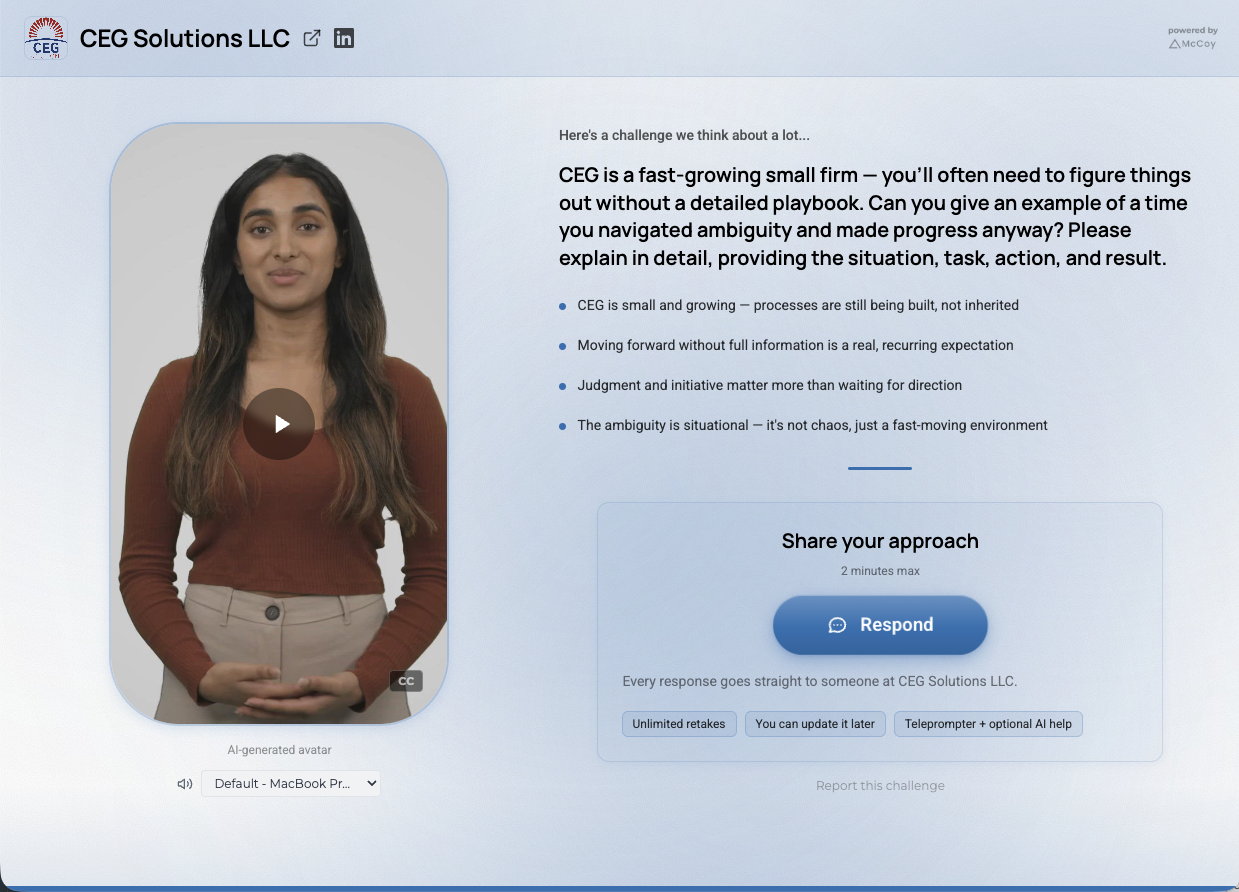
The question she wrote was anchored to how CEG actually works, fast-moving, with no detailed playbook, where judgment and initiative matter more than waiting for direction. It was the same thing she listens for on a phone screen, but asked of every candidate at once. She capped each response at two minutes.
Each challenge includes a short video that gives candidates more context. Rather than record it herself, she opted for McCoy IQ's AI avatar.
"I can see why some recruiters or hiring managers would want to record an intro video to go with the challenge, but I love the ability to just let an AI avatar do it."
Lisa’s challenge
Create one like it →Adding the Challenge to the Process
Lisa reviewed resumes the way she always does and narrowed the pool to 25 to 30 promising candidates. Under her normal process, each of them would have gotten a 30-minute phone screen. That is 12.5 to 15 hours on a single role.
Instead, she sent them the challenge. CEG runs its hiring through BreezyHR, and none of that changed. Lisa copied the challenge link from the McCoy IQ portal into the email she already sends shortlisted candidates, and the responses came back into the portal for her to review. The candidates she wanted to advance, she marked in BreezyHR for a phone screen, the same way she always has. McCoy IQ was one added step in her funnel, not a replacement for it.
What the Videos Showed Her
Ten candidates recorded video responses, which helped narrow her candidate pool to phone screen. She could see how each person thought and approached the work, the part a resume never shows. She could hear directly from candidates instead of reading about them.
She gave a phone screen to the people who responded, and skipped the phone screen she'd otherwise have run for the fifteen to twenty who didn't respond. That was 7.5 to 10 hours back on her calendar, time she could put toward the other roles she was filling.
"The resumes were all telling me the same story. The videos were where I could finally see how each person thinks. By the time I got someone on the phone, I already knew why I wanted to talk to them.”
During the phone screen she makes sure they answer a set series of questions. She verifies that they can support CEG's request to submit a writing sample. From there she makes the recommendation for the hiring team to interview.
What It Was Like for Candidates
One of Lisa's worries had been the candidates, whether a video step would feel like a hoop and cost her good people. So she asked the ones she spoke with. They told her it was fast and easy. The median candidate spent about 22 minutes start to finish, only around five of them on camera and the rest thinking through what to say, much of that in conversation with McCoy IQ's AI about what to cover. And some of the strongest resumes in the pool were among the candidates who responded, so the step she'd worried might drive good people away didn't.
The Hire
One of the candidates who recorded a response interviewed at CEG and got the job, and Lisa got there without phone-screening the whole shortlist to find them.
“It's an amplifier for the resume. You get to see how someone thinks, not just what's on the page.”
One role was all it took for her to see what it could do.
I'd tell other recruiters to just try it. Pick one role, put a challenge in front of your shortlist, and see what comes back. That first batch of responses will tell you everything.
 Lisa Cortese · Talent Acquisition Manager, CEG Solutions